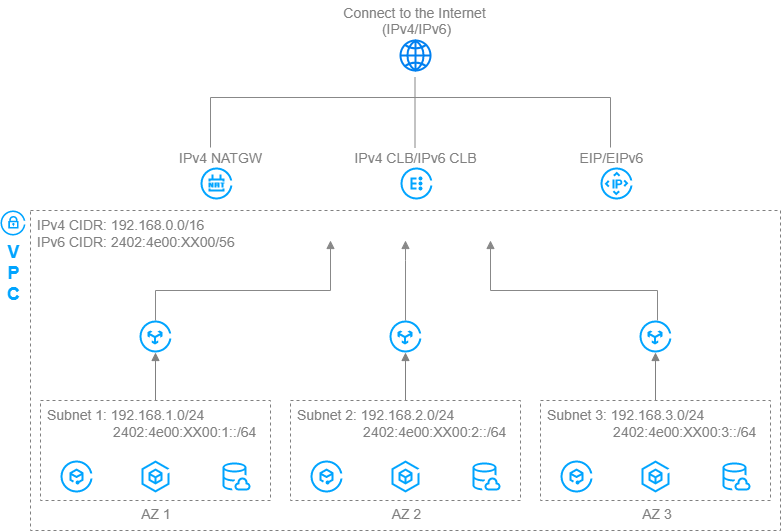
Scenario 1: Building IPv4/IPv6 dual-stack communication within a VPC
You can quickly build an IPv4/IPv6 dual-stack VPC by enabling IPv6.
- After the VPC obtains the IPv6 CIDR, the VPC will support IPv4 and IPv6 dual protocol stacks.
- After the CVM obtains IPv6, it will also support IPv4 and IPv6 dual protocol stacks.
- By default, IPv6 communication between CVMs in the same VPC is supported, but IPv6 communication between CVMs in different VPCs is not supported.
- By default, the CVM cannot access the IPv6 public network. You need to manually enable the IPv6 public network bandwidth for the CVM before it can access the IPv6 public network.
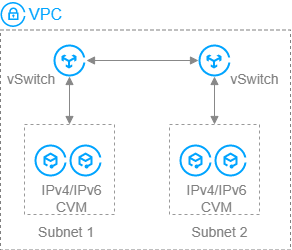
Scenario 2: Building IPv6 public network communication for CVM
After the CVM obtains IPv6, it will run IPv4 and IPv6 dual protocol stacks simultaneously.
- You can enable IPv6 public network access for your CVM through Elastic IPv6, while the CVM can still access the IPv4 public network through IPv4 EIP or IPv4 NAT gateway.
- The public network access settings of IPv6 and the settings of IPv4 EIP will not affect each other. Therefore, if the public network is enabled only for IPv6, while the IPv4 EIP is not set, the CVM cannot access the IPv4 public network.
- You can set the maximum bandwidth for the CVM IPv6 public network. Through refined IPv6 public network bandwidth thresholds and default basic anti-DDoS policy, you can effectively improve security protection capabilities.