

HTTPS Listener Introduction
You can add an HTTPS listener on the CLB instance to forward HTTPS protocol requests from clients. The HTTPS protocol is suitable for HTTP applications that require encrypted transmission.
Configuring an HTTPS Listener
Step 1: Open the Listener Management page
- Log in to CLB control and click LB Instance List in the left sidebar.
- On the CLB instance list page, click the target instance ID.
- On the instance details page, click the Listener Management tab page.
Step 2: Configure the listener
In the HTTP/HTTPS Listener module, click Create and configure an HTTPS listener in the pop-up.
1. Create a listener
| Basic Configuration of Listener | Description | Example |
|---|---|---|
| Name | The name of the listener. | test-https-443 |
| Listen Protocol Port | The listener's protocol and listening port. - Listener protocol: The protocols supported by CLB under this listener include HTTP and HTTPS. In this example, HTTPS is selected. - Listening port: The port is used to receive requests and forward them to the backend server. The port range is 1-65535. - The listening ports in the same CLB instance cannot be repeated. |
HTTPS:443 |
| Default Domain Name | You can choose to enable or disable it. - Enable: When the client request does not match any domain name of this listener, CLB will forward the request to the default domain name (Default Server). Each listener can only be configured with one default domain name. - If your Layer-7 listener has been configured with a default domain name, client requests that do not match other rules will be forwarded to the default domain name. - If your Layer-7 listener is not configured with a default domain name, client requests that do not match other rules will be forwarded to the first domain name loaded by the CLB. Since the loading order may be inconsistent with the console configuration order, it is not necessarily the first one configured by the console. - Disable: When the client request does not match any domain name of this listener, the request will not be forwarded. |
Enable |
| Enabling SNI | Enabling SNI means that different certificates can be configured for different domain names under a listener. Not enabling SNI means that multiple domain names under the listener use the same certificate. | Enable |
| SSL Parsing Method | Support one-way authentication and two-way authentication. | One-way Authentication |
| Server Certificate | You can select a certificate from the SSL certificates platform or upload a certificate. | Selecting an Existing Certificate |
The specific configuration for creating an HTTPS listener is shown in the figure below.

2. Create forwarding rules
| Basic Configuration of Forwarding Rules | Description | Example |
|---|---|---|
| Domain name | Request a domain name. - Support precise domain names, such as www.example,com. Support wildcard domain names, such as *.example.com or www.example.* , in a single domain name * Can only appear once.- The character sets supported by irregular domain names are as follows: az``0-9``.``-.- Support regular expressions. The character sets that are not supported in regular expressions are as follows: "``{``}``;``\```````~`````Space.- The domain name length limit is 1-120. |
www.example.com |
| Default Domain Name | - When all domain names in the listener are not matched successfully, the system will direct the request to the default access domain name to make the default access controllable. - Only one default domain name can be configured for a listener. |
Enable |
| URL Path | Request path. - The default is /, must be preceded by /.The length limit is 1-120.- Non-regular URL path starts with / . The supported character sets are as follows: a-z``A-Z``0-9``.``-``/``=``? .- Support regular expressions. - Beginning with = indicates an exact match.- Beginning with ^~ indicates that the uri starts with a regular character string, not a regular match.- Beginning with ~ indicates a case-sensitive regular match.- Beginning with ~* indicates a case-insensitive regular match.- / means universal matching. Any request will be matched if there is no other match.- For the regular URL, unsupported character sets are as follows: "``{``}``;``\ ``` ~`````Space. |
/index |
| Balance Mode | In the HTTPS listener, CLB supports three scheduling algorithms: weighted round-robin (WRR), weighted least connections (WLC), and IP Hash. - Polling by Weight: Distributes requests to different servers in sequence based on the weights of the backend servers. The weighted round-robin algorithm schedules based on Create connection count, where servers with higher weights are polled more frequently (probability), and servers with the same weight handle an equal number of connections. - Min. Weighted Connections: Estimate the server's load based on the currently active number of connections. The weighted least connections scheduling algorithm takes into account both the server's load and its weight for comprehensive dispatching. When the weight values are the same, the backend server with a smaller current number of connections is polled more frequently (probability). - IP Hash: Based on the source IP address of the request, use the Hash key to find the corresponding server from the statically allocated hash table. If the server is available and not overloaded, the request is sent to the server; otherwise, it returns nothing. |
Poll by weight. |
| Obtain Client IP address | Enabled by default. | Enabled |
| Gzip Compression | Enabled by default. | Enabled |
| SSL Parsing Method | Support one-way authentication and two-way authentication. | One-way Authentication |
| Server Certificate | You can select a certificate from the SSL certificates platform or upload a certificate. | Selecting an Existing Certificate |
Select the HTTPS listener for which you need to create a forwarding rule, click Add Rules to create the rule, and the basic configuration is shown in the figure below.
3. Health check
| Health Check Configuration | Description | Example |
|---|---|---|
| Health Check | Enable or disable health check. In the HTTPS listener, the CLB instance sends an HTTPS request to the specified server port for a health check. | Enable |
| Check Domain Name | Request a domain name. - The default is the access domain name. - Supported character sets include: az``0-9``.``-, length limit is 1-120.- Regular expressions are not currently supported. - When the user fills in the domain name as a wildcard domain name, it is necessary to specify a fixed domain name (non-regular) as the health check domain name. |
Use the default value (that is, www.example.com). |
| Check Directory | Request path. - The default is /, must start with /.- Supported character sets include: az``0-9``.``-, length limit is 1-120.- Regular expressions are not currently supported. - It is recommended to specify a fixed URL path (static page) for a health check. |
Use the default value (that is, /). |
| Detection Interval | - The interval for the CLB health check. - Configurable range: 5-300 seconds, default value is 5 seconds. |
5s |
| Unhealthy Threshold | - If the health check results received for n consecutive times (n is the filled value) are failed, it is identified as unhealthy, and the console displays as Abnormal. - Configurable range: 2-10 times, default value is 3 times. |
3 times |
| Health Threshold | - If the health check results received for n consecutive times (n is the filled value) are successful, it is identified as healthy, and the console displays as Healthy. - Configurable range: 2-10 times, default value is 3 times. |
3 times |
| HTTP Request Method | HTTP request method for the health checks, optional: GET or HEAD, the default is GET. - If the HEAD method is used, the server only returns the HTTP header information, which can reduce backend overhead and improve request efficiency. The corresponding backend service must support HEAD. - If the GET method is used, the backend service only needs to support GET. |
GET |
| HTTP Status Code Detection | When the status code is the selected status code, the backend server is considered alive, that is, the health check is normal. Optional: http_1xx, http_2xx, http_3xx, http_4xx, http_5xx. | Multiple selection: http_1xx, http_2xx, http_3xx, http_4xx |
The specific configuration of the health checks is shown in the figure below.

4. Session persistence
| Session Persistence Configuration | Description | Example |
|---|---|---|
| Session Affinity Status | Enable or disable session persistence. - After session persistence is enabled, the CLB listener will distribute access requests from the same client to the same backend server. - The HTTPS protocol is based on Cookie session persistence, and the CLB embeds Cookies into the client. - Weighted round-robin scheduling supports session persistence, while weighted least connections and IP Hash scheduling do not support session persistence. |
Enable |
| Session Hold Time | Session hold time. - When the hold time is exceeded and there is no new request in the connection, the session will be automatically disconnected. - Configurable range 30-3,600 seconds. |
30s |
The specific configuration of session persistence is shown in the following figure.

Step 3: Bind the backend CVM
- On the Listener Management page, click the created listener, click the triangle on the left side to expand the domain name and URL path, select a specific URL path, and view the backend services bound to the path on the right side of the listener.
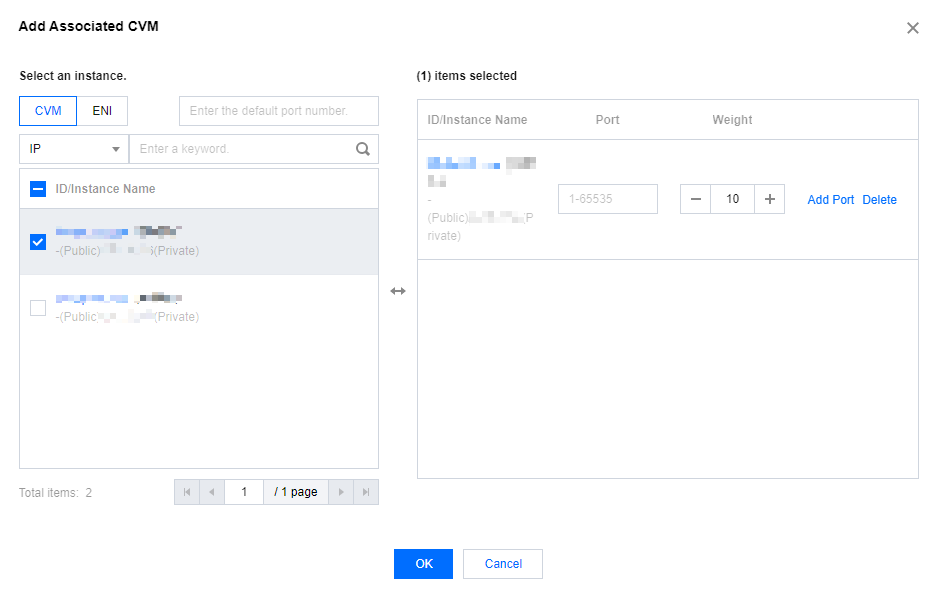
- Click Bind, select the backend server to be bound in the pop-up, and configure the service port and weight.
- Add port feature: In the Selected CVM box on the right, click Add Port to add multiple ports of the same CVM.
- Default port feature: Fill in Default Port first, then select the CVM. The port of each CVM is the default port.
After completing Step 1 to Step 3, the HTTPS listener rules are configured.
Step 4: Modify/delete listeners (optional)
If you need to modify or delete a created listener, on the Listener Management page, click the created listener/domain name/URL path and select modify or delete to complete the operation.