

- Event overview
An event is a medium that carries information, describing a non-persistent change of a specific object at a particular moment, associated with a unique moment and a unique object. For example, a computer changing from running to shutdown status, the start and end of a program run, or a power outage in an office building. An event is a record of the change at a moment between two different states of an object.
The purpose of monitoring services is to assist in the discovery, location, and resolution of issues, ensuring the overall stability and performance of systems and services. Information and data are the core drivers of Ops and monitoring.
Metrics, as the primary source of monitoring information, describe the numerical values and trends of specific variables of particular objects over time in a threshold-based, periodic, persistent form. They reflect the usage and health status of resources and environments. For example, the CPU utilization of a CVM and the number of slow queries in a database instance.
Metrics can cover the vast majority of scenarios where monitoring identifies issues. However, using metrics alone as the monitoring information source has the following drawbacks:- Information transmission latency: Changes in metric thresholds may only become apparent (or not at all) some time after a specific event has occurred.
- Low accuracy and distinguishability of transmitted information: It becomes more challenging to determine and locate real events or the causes of issues based only on changes in thresholds.
- Limited dimensions of information: Metrics record information only in threshold form, lacking the capability to provide additional supplementary and ancillary information through textual means.
Events are introduced as a carrier of monitoring information to more accurately and directly describe the operational status of resources and underlying infrastructure services, facilitating the discovery, location, and resolution of issues in a more efficient manner.
The advantages of introducing events include improving information accuracy in a result-oriented manner, reducing latency, conveying more information, and enhancing the dimensionality of monitoring information.
- Event Center introduction
As the event information center of the cloud platform, Cloud Monitor's Event Center manages the important event information during the lifecycle and running of all product resources on the cloud platform. It builds a complete event consumption channel and process to support users' monitoring and Ops on the cloud.
The event information provided by Event Center is obtained from various product modules and underlying infrastructure services on the cloud platform. It is then aggregated, determined, condensed, and finally displayed. The information sources originate from the underlying system logs and monitoring items of each module, ensuring the accuracy and value of the information for users. - Event Type
Based on the information source, cause, characteristics, and form of events, the events covered by Event Center are divided into two main categories: product events and platform events, each supported by two separate product pages and consumption processes.- Product events: They originate from the products and resource instances (such as a CVM instance) used by users on the cloud. They are directly or indirectly triggered by users' operational behaviors during use, and belong to the dimension specific to particular resource instances. Users have control over the events and the ability to handle them themselves. The impact and associated resource instances of the events can be identified.
- Platform events: They are generated in the underlying infrastructure and services that support the cloud platform (such as the virtualization layer VMM, underlying physical servers, networks, and storage modules that support CVM). They are generated or caused by the underlying infrastructure and services that support the cloud platform. Since the root causes of events are not user behaviors and events belong to the service dimension, users can not control these events, and only the cloud platform has the handling capability. Services and product modules affected by and associated with events can be identified, but the affected and associated resource instances may not be identified.
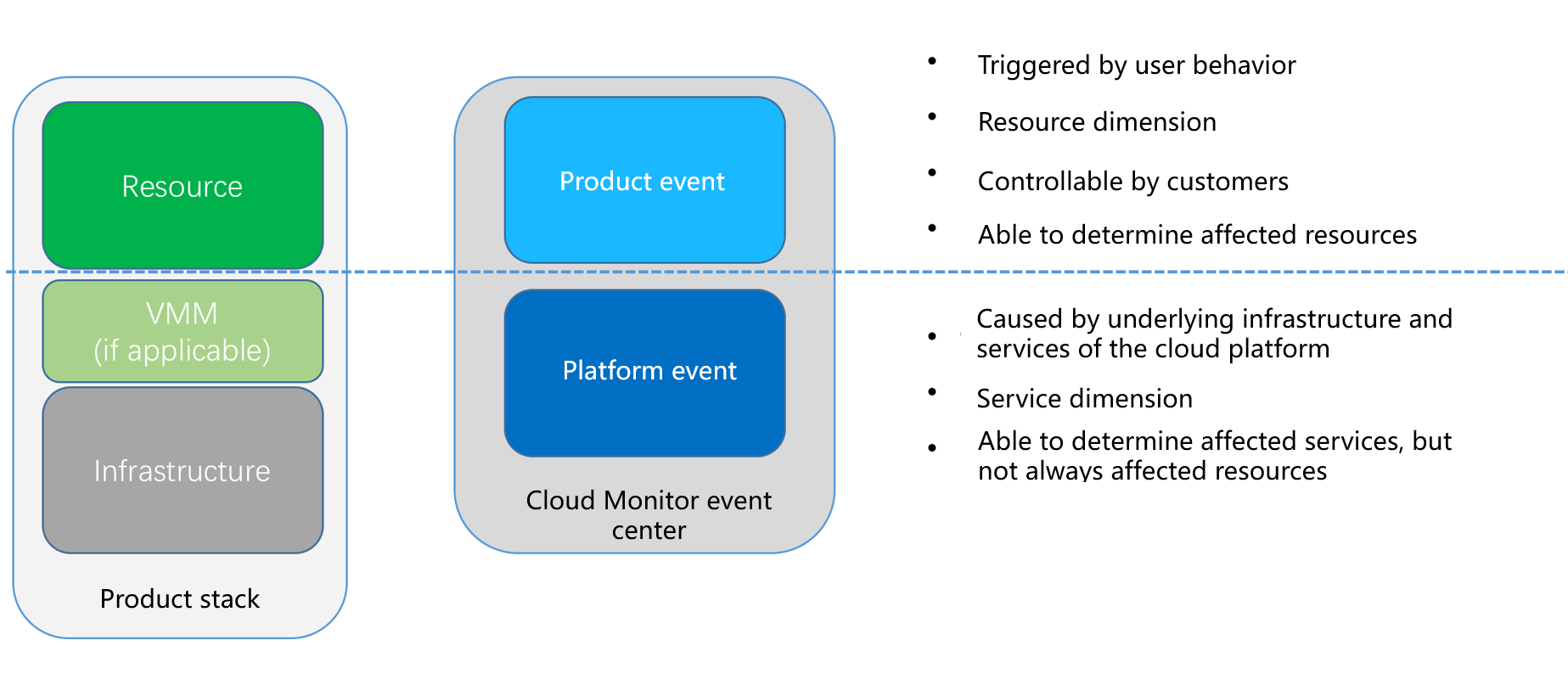
- Event comparison
Comparison Item Product Event Platform Event Event source Products and resource instances used by users on the cloud. Underlying infrastructure services of the cloud platform. Event cause Directly or indirectly triggered by users' operational behaviors. Generated or caused by the underlying cloud infrastructure and services. Event dependency dimension Resource instances. Underlying services. Event handling capability Users have control over the events and can handle them themselves. Users have no control over the events and need the cloud platform to handle them. Event-related object granularity The impacted and associated resource instances can be clearly confirmed. The impacted and associated underlying services or product modules can be confirmed, while the impacted resource instances upstream may not be confirmed.
- Event Center use cases
Based on event information, Event Center plans and provides comprehensive event consumption channels and capabilities.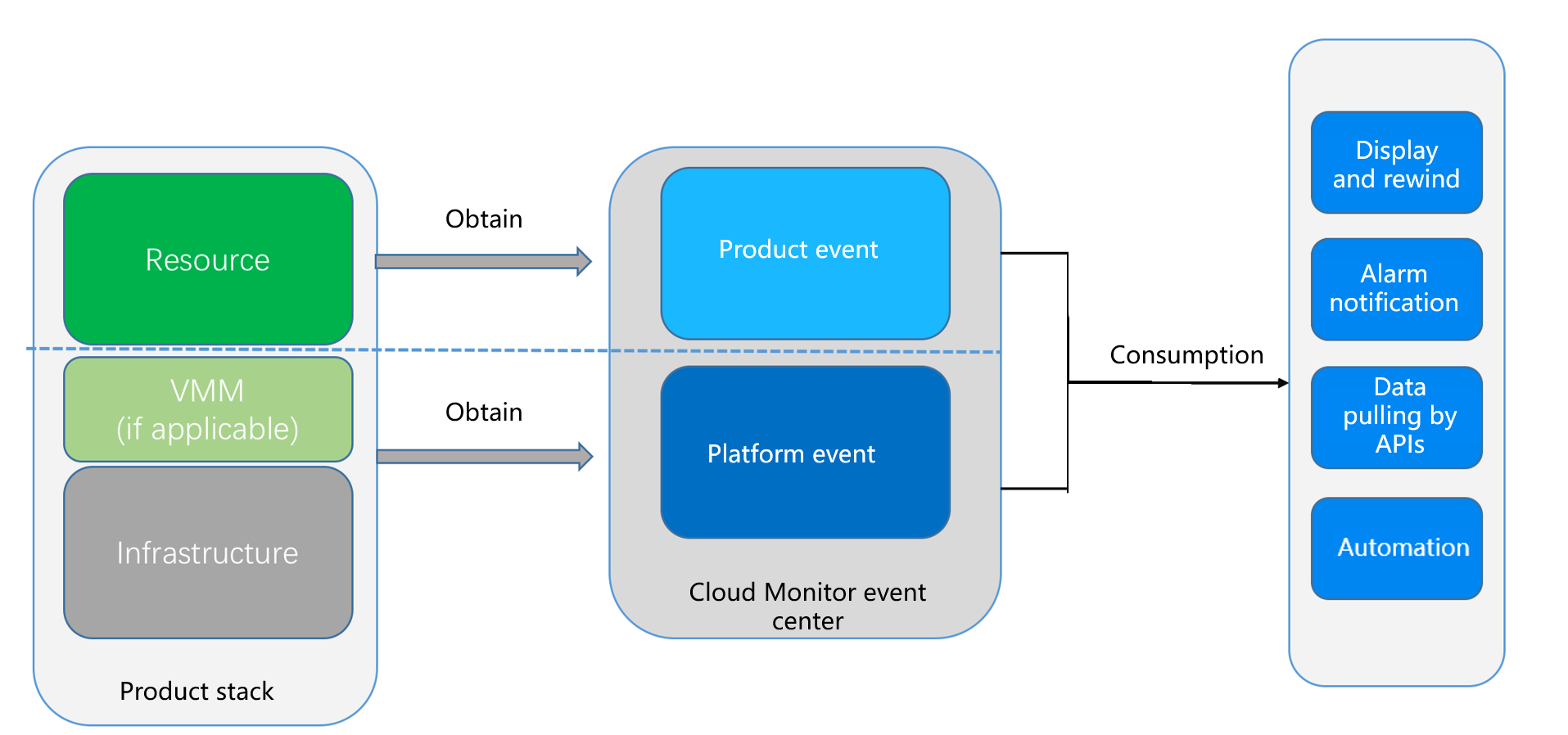
- Presentation and tracing: Records all event information related to the account, with the console providing the ability to view, globally filter, search, and trace event information.
- Alarm notifications: Enables users to receive alarms or subscribe to notifications for monitored events and resources, ensuring timely communication with the owner.
- Retrieval with APIs: Provides APIs to retrieve event information for integration with self-built monitoring systems.
- Automation: Subsequent updates will support configuring linked invocation operations with events as triggers, enabling users to achieve automated Ops.
- Benefits
- It enhances the monitoring information dimensions of cloud resources, providing more comprehensive data support for monitoring and Ops.
- It provides event information consumption channels, aiding in the transformation of monitoring information into value.
- It converges determination logic to more efficiently and directly pinpoint impacted resources and causes.
- It allows traceable review of event information, ensuring awareness of significant changes in resource and platform lifecycle events.
- It can trigger automatic responses to specific resource and environment changes.
