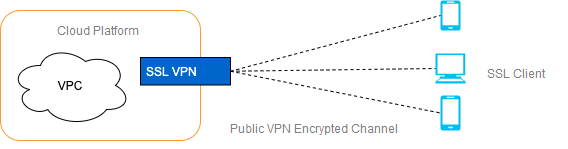
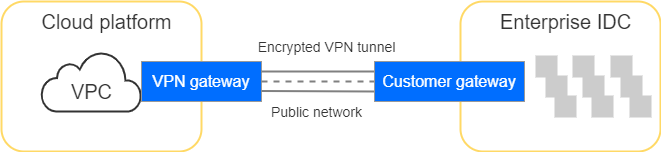
A VPN connection is a way to achieve remote access through an encrypted public network channel. VPN gateway is an important part of VPN connection. There are two types of VPN gateways:
IPsec VPN Gateway: Mainly realizes site-to-site interconnection. For example, when IDC is connected to a VPC, after a VPN connection is established, you only need to configure the relevant routing policies in the routing table to achieve communication.
VPN gateway: An IPsec VPN gateway created in the VPC.
Customer Gateway: A logical object that records the public IP address of the IPsec VPN gateway on the IDC side (the IDC side must have a fixed public IP).
VPN Channel: An encrypted IPsec VPN channel connecting the VPN gateway and the customer gateway. Each VPN gateway can establish multiple VPN channels, and each VPN channel can connect to a local IDC.
SSL VPN Gateway: Mainly realizes point-to-point interconnection. For example, you can access the VPN server through any browser with built-in SSL to access the VPC. As shown in the figure below, an SSL VPN connection is divided into the following components.
VPN Gateway: SSL VPN gateway created in the VPC.
SSL Server: The service module in the VPN gateway used to provide SSL services, mainly implementing the encapsulation and decapsulation of data packets.
SSL Client: Any browser with built-in SSL can be used as an SSL client to access.